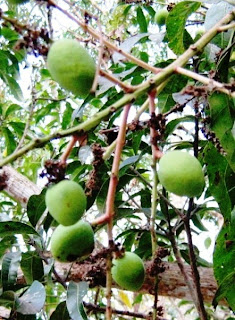
I took this photograph at Olavipe about two weeks back. The mango trees in that area had flowered early this year but because of mist at night and clouds, most of the blooms dropped off. Normally there would be another round of flowering. I hope it happens and that we would have a good supply of the ‘king of fruits’.
How did the name ‘mango’ originate? One story is that it stems from the Tamil word mangkay. The Portuguese called it manga. That is the Malayalam name as well. According to Wikipedia, the Vedas refer to it as ‘food of the gods’.
The fruit is considered to be very healthy. Mangoes are fiber rich and are known to be a good source for Vitamins A and C, beta carotene and potassium. The calories, sodium and fat content are low. It is said to increase sexual potency and to have medicinal properties too.
Mangoes have an important place in several Indian cuisines. Traditionally many people in India have been using the twigs and leaves from mango trees for cleaning teeth. Possibly the idea of chlorophyll toothpastes was inspired by this.However, some people are allergic to the sap and even the fruit itself, and to parts of the tree.
The mango tree is considered as a symbol of love. In many parts of India, mango leaves are invariably used for decorations on festive occasions.
Even as I write this my mind is on the tender mangoes that are growing to maturity back home. Of course one can buy the fruit anywhere, but for me there is nothing like the mangoes of Olavipe. I plan to be there when they ripen.
A Public Domain image from Wikimedia Commons showing details of mango is reproduced below:

Ends.
Also see:


